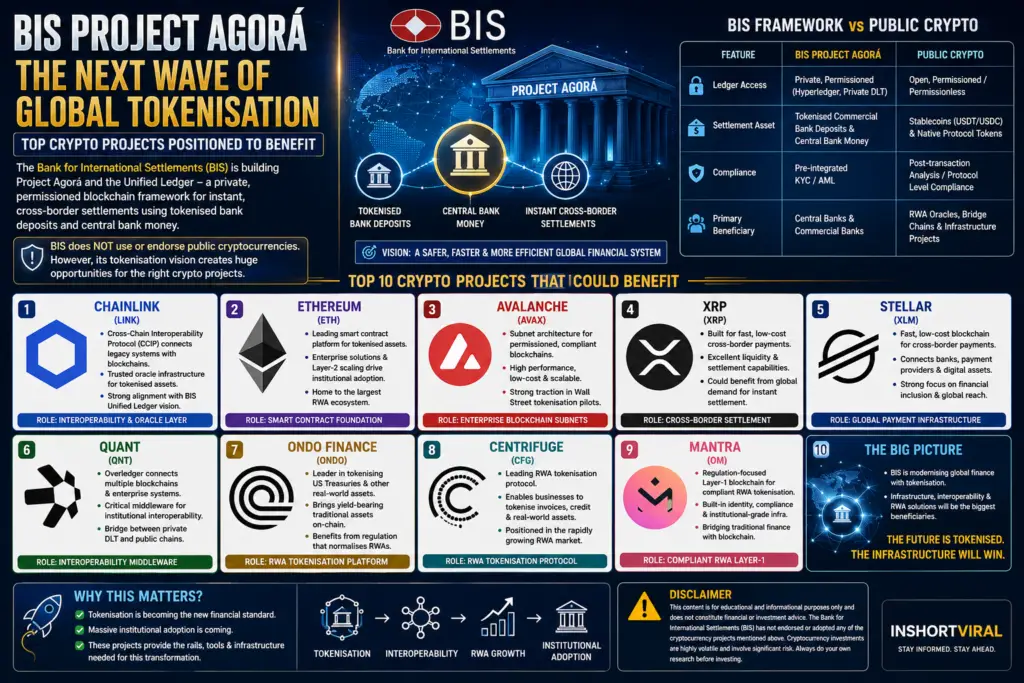
BIS Project Agora Explained: Could LINK, XRP, XLM, QNT, AVAX, ETH & RWA Crypto Projects Benefit?
The global financial system is entering a new era of digital transformation, and one of the biggest developments comes from the **Bank for International Settlements (BIS)** through its ambitious **Project Agora** and **Unified Ledger** initiative.
Many investors believe BIS is preparing to adopt cryptocurrencies, but that is **not the case**.
Instead, BIS is building a **private, permissioned blockchain infrastructure** designed specifically for central banks and commercial financial institutions. The goal is to modernize global payments using tokenized commercial bank deposits and central bank reserves while maintaining regulatory compliance and financial stability.
Although public cryptocurrencies are **not part of the BIS infrastructure**, the broader push toward tokenization could create significant long-term opportunities for blockchain projects that provide interoperability, enterprise infrastructure, and Real-World Asset (RWA) solutions.
# What is BIS Project Agora?
Project Agora is a collaborative initiative led by the Bank for International Settlements (BIS) together with multiple central banks and commercial financial institutions.
Its objective is to create a next-generation financial system where tokenised commercial bank deposits and central bank money can move instantly across borders through a secure distributed ledger.
Unlike Bitcoin or other public blockchains, Project Agorá operates on a **private permissioned blockchain architecture**, ensuring:
• Regulatory Compliance
• Built-in KYC & AML
• Faster Cross-Border Settlement
• Institutional Security
• Financial Stability
This approach protects what BIS describes as the **”Singleness of Money”**, allowing digital payments while maintaining trust in regulated financial systems.
Why Public Crypto Still Matters
While BIS is not adopting public cryptocurrencies, its tokenisation strategy validates blockchain technology as the future infrastructure of global finance.
As banks move trillions of dollars worth of traditional assets onto blockchain networks, demand for interoperability, tokenisation platforms and enterprise blockchain infrastructure is expected to increase significantly.
This is where several public blockchain projects may benefit.
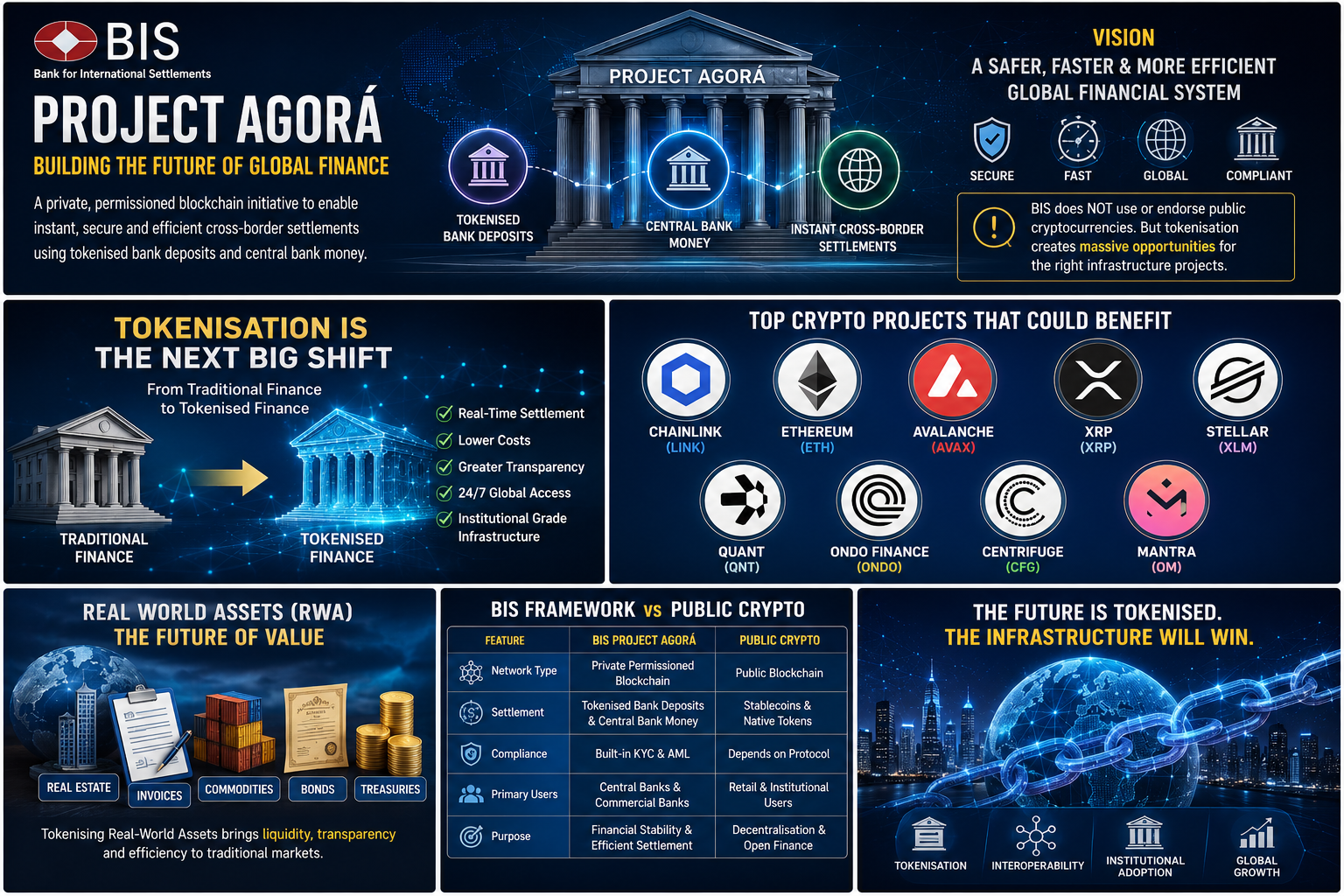
Top Crypto Projects Positioned to Benefit
1. Chain-link (LINK)
Chainlink remains one of the strongest infrastructure providers in the blockchain industry.
Its Cross-Chain Interoperability Protocol (CCIP) allows financial institutions to securely transfer information and tokenised assets across multiple blockchain networks.
Why LINK matters:
✔ Cross-chain interoperability
✔ Institutional partnerships
✔ Oracle infrastructure
✔ Real-World Asset ecosystem
2. Ondo Finance (ONDO)
Ondo Finance specializes in tokenized U.S. Treasury products and institutional Real-World Assets.
As tokenized securities become more common, platforms offering compliant financial products may experience increased institutional demand.
3. MANTRA (OM)
MANTRA is developing a regulation-focused Layer-1 blockchain specifically designed for Real-World Asset tokenization.
Its infrastructure includes:
• Digital Identity
• Compliance
• Institutional Applications
• RWA Infrastructure
As governments and institutions embrace tokenisation, MANTRA could become an important player.
4. Centrifuge (CFG)
Centrifuge enables businesses to tokenize invoices, private credit, real estate and other real-world assets.
The protocol focuses entirely on bringing traditional finance onto blockchain networks, making it one of the most recognized RWA projects.
5. XRP
XRP has spent years focusing on fast, low-cost international payments.
Although BIS is developing its own settlement infrastructure, increasing demand for real-time global settlement may indirectly support technologies offering similar capabilities.
6. Stellar (XLM)
Stellar was built to improve global payments and financial inclusion.
Its low-cost payment infrastructure and strong cross-border capabilities make it one of the projects investors continue to monitor as tokenisation expands worldwide.
7. Quant (QNT)
Quant’s Overledger technology connects multiple blockchain networks together.
As banks adopt different blockchain infrastructures, interoperability solutions like Quant may become increasingly valuable.
8. Avalanche (AVAX)
Avalanche’s Subnet architecture enables institutions to create private, permissioned blockchain environments while maintaining access to broader blockchain liquidity.
This makes Avalanche attractive for enterprise blockchain deployment.
9. Ethereum (ETH)
Ethereum remains the world’s largest smart contract ecosystem.
Most tokenised assets, institutional blockchain applications and Layer-2 scaling solutions continue to be built on Ethereum.
Its dominance makes it one of the foundational technologies behind digital finance.
#BIS Framework vs Public Crypto
Feature | BIS Project Agora | Public Crypto
——- | —————- | —————-
Network | Private Permissioned Blockchain | Public Blockchain
Settlement | Tokenized Bank Deposits & Central Bank Money | Stable coins & Native Tokens
Compliance | Built-in KYC & AML | Depends on Protocol
Users | Central Banks & Commercial Banks | Retail & Institutional Users
Why Investors Are Watching This Trend
Project Agorá represents more than just another banking experiment.
It demonstrates that central banks now recognize blockchain technology as a critical part of future financial infrastructure.
While public cryptocurrencies are not directly involved, blockchain companies building:
• Cross-chain Infrastructure
• Tokenisation Platforms
• Enterprise Blockchain Solutions
• Real-World Asset Protocols
may benefit from the broader adoption of tokenised finance.
Final Thoughts
The Bank for International Settlements is not replacing traditional finance with public cryptocurrencies.
Instead, it is building a regulated blockchain ecosystem designed specifically for institutional use.
However, the growth of tokenisation could create enormous opportunities for blockchain projects providing the infrastructure required to connect banks, institutions and digital assets.
Projects such as Chainlink, Ethereum, Avalanche, XRP, Stellar, Quant, Ondo Finance, Centrifuge and MANTRA continue to attract attention because they operate in sectors that closely align with the future direction of institutional blockchain adoption.
As always, investors should focus on long-term fundamentals, conduct independent research and understand the risks before making investment decisions.
Disclaimer
This article is intended for educational and informational purposes only and should not be considered financial or investment advice. The Bank for International Settlements (BIS) has not endorsed or adopted any of the cryptocurrency projects mentioned in this article. Cryptocurrency investments involve substantial risk. Always conduct your own research and consult a qualified financial advisor before investing.